I'm 19, Building Out of Bengaluru. Here Is Why Most Indian Students Are Locked Out of Frontier AI
Published: 2026-10-04 · 8 min read · Poorvith M P
I'm 19, Building Out of Bengaluru. Here Is Why Most Indian Students Are Locked Out of Frontier AI
**Published:** October 4, 2026
**Author:** Poorvith M P
**Platform Link:** [Read on LinkedIn](https://www.linkedin.com/pulse/im-19-building-out-bengaluru-here-why-most-indian-students-m-p-eygic)
**Companion Post:** [LinkedIn Post](https://www.linkedin.com/posts/poorvithmp_im-19-building-out-of-bengaluru-here-is-activity-7512413737996156929-ouOS)
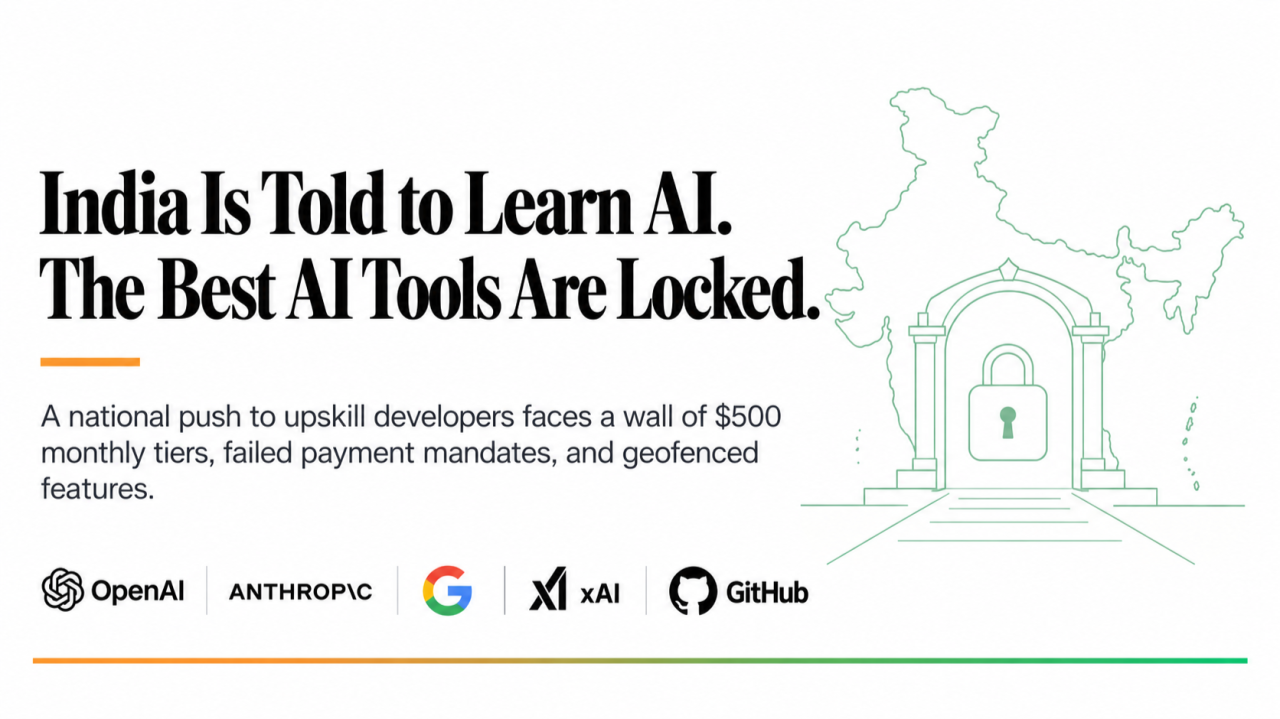
Every week on campus and online, I hear the same message: "India is going to lead the AI revolution. Learn the modules; don't fall behind. Otherwise, AI will take your job." The Indian government actually approved ₹10,372 crore for the India AI mission. GitHub data shows India has over 13 million developers and is on track to overtake the US by 2027, hopefully. Colleges are adding AI courses to every system, every semester syllabus. If they are autonomous, the ambition is real, but when you sit down at your desk and try to build production-grade agentic tools, you run straight into three walls nobody talks about in keynotes:
### 1. The Currency & Purchasing Power Wall
First, the currency math: a basic ChatGPT Plus or Claude Pro tier is $20 a month, roughly ₹2,000. That is manageable for some students, but modern software engineering no longer runs on basic chat windows. Real autonomous development happens on multi-agent harnesses, large context windows, and frontier tasks. OpenAI and Anthropic have introduced developer and Pro tiers ranging from $200 to $500 a month, which roughly takes about ₹20,000 to ₹50,000 per month.
Look at the Indian median starting salary for an engineering graduate in India, which ranges between ₹3.5 lakh and ₹4 lakh per annum. That works out to roughly ₹32,000 to ₹35,000 in monthly take-home pay. A single developer subscription in the US costs more than an Indian junior engineer's entire monthly livelihood. In San Francisco, a $300 tier is a trivial corporate card swipe. In India, paying US dollar subscription rates without purchasing power parity (PPP) makes frontier AI an economic impossibility for students and independent builders.
### 2. Payment Gateways & RBI E-Mandate Friction
Second, our payment gateways don't talk to global processors. The Reserve Bank of India (RBI) enforces an e-mandate regulation requiring additional factor authentication (AFA) and advance debit notices on recurring transactions. International billing setups like Stripe often fail to process Indian credit and debit cards smoothly. Even when Indian students save up the money to buy API credits, their card declines. Instead of shipping code, they spend the weekend troubleshooting bank authorisation errors. Even I have experienced this so many times.
### 3. Geographic Feature Lockouts
Third, geographic feature lockouts: frontier labs announce experimental autonomous agents, real-time voice features, or student plans—like OpenAI announcing 4 months free for US students, where Indian students are not eligible. Even students active in open-source contributions often get locked out of regional rollouts that start exclusively in North America and Europe, leaving Indian builders staring at waitlists and regional restrictions. We are told to compete with the world, but the starting line is pushed back for us.
### How Indian Builders Adapt Through Architecture
What happens as a result? Indian developers are adapting by learning systems engineering out of necessity. Because I can't burn $100 on an unconstrained cloud agent, I don't use raw prompt dumping. I run local weights through Ollama, build locally, use SQLite indexing to persist state, and use Tree-sitter AST parsers to keep my active context under 16k tokens. Silicon Valley developers often solve inefficiency by spending more company compute; Indian developers are forced to solve inefficiency through cleaner architecture.
### Three Changes Global AI Labs Need to Make
If global AI labs genuinely want India's 30 million developers building on their platforms, they need to do three things:
1. **Introduce genuine purchasing power parity (PPP) pricing** for students and solo builders, as Cursor did for Indians with the ₹650 plan.
2. **Support native UPI and domestic rupee billing** to clear the recurring payment hurdle.
3. **Stop geo-fencing feature betas and developer programs** away from non-Western regions.
Until then, the developers building with local-first tools and lean architectures won't just survive the price barrier—they will build more efficient software than engineers who take infinite compute for granted.