The Verification Bottleneck: Why Free Code Generation Is Creating a $100B Review Crisis
Published: 2026-09-26 · 9 min read · Poorvith M P
The Verification Bottleneck: Why Free Code Generation Is Creating a $100 Billion Review Crisis
**Published:** September 26, 2026
**Author:** Poorvith M P
**Platform Link:** [Read on LinkedIn](https://www.linkedin.com/pulse/verification-bottleneck-why-free-code-generation-creating-m-p-kvmmc)
**Companion Post:** [LinkedIn Post](https://www.linkedin.com/posts/poorvithmp_the-verification-bottleneck-why-free-code-activity-7509478413410258944-Cfuj)
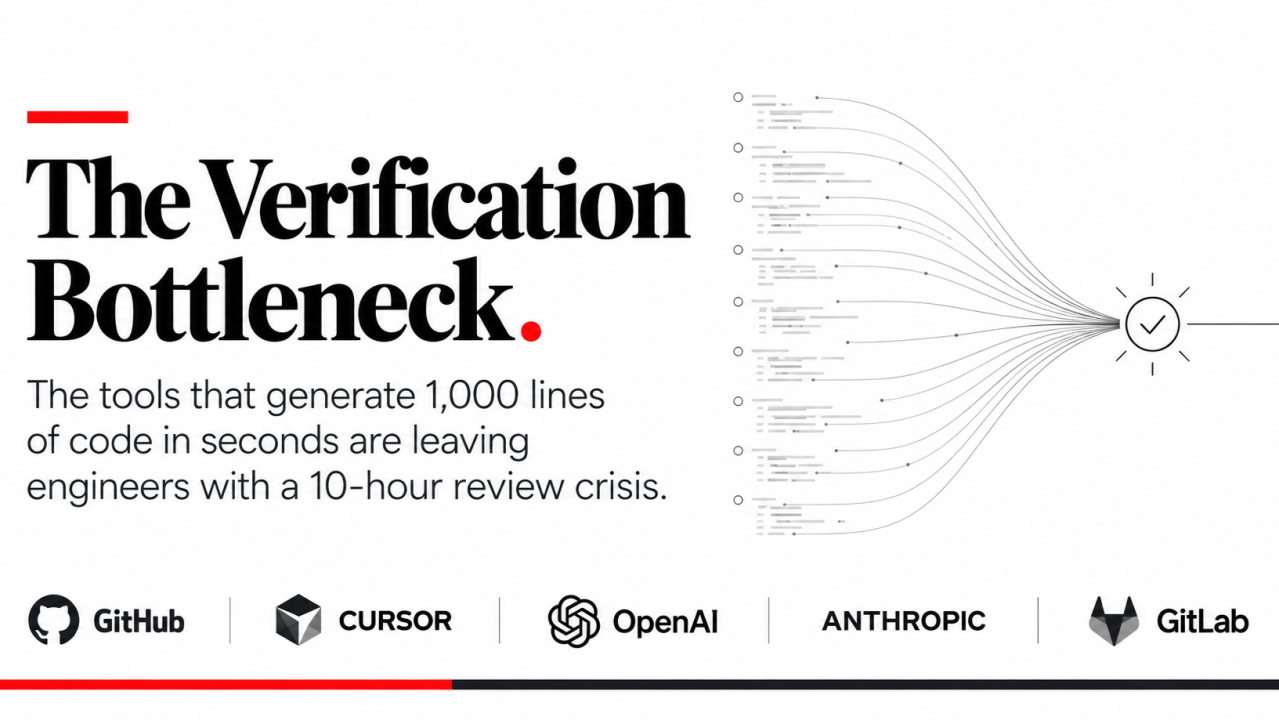
Writing code just dropped toward zero dollars. Reviewing it has never been more expensive.
On Tuesday, Anthropic dropped Claude Opus 5.5, taking the top spot on the Artificial Analysis Index at 58 while cutting token generation costs by 40%. OpenAI countered with GPT-6 Sol and Luna, dropping inference costs by another 50%. Coding agents can now generate 400 lines of syntactically valid TypeScript in ten seconds for less than half a cent.
The engineering industry is celebrating the death of the blank editor screen.
They are celebrating too early.
What we solved was syntax generation. What we created is an unprecedented verification crisis. When you produce software at zero marginal cost, the bottleneck does not disappear; it shifts violently to the human engineers tasked with reading, testing, and debugging the output.
We built an engine that writes code faster than humans can think, and we hooked it directly into production pull request queues.
### The Asymmetry of AI Code
There is a fundamental asymmetry between generating software and verifying it:
- An LLM takes 8 seconds to write an Express authentication handler with token refresh logic.
- A senior engineer takes 45 minutes to trace whether that handler handles clock skew, drops expired refresh tokens from Redis, strips bearer headers across redirects, and fails closed when an environment variable is missing.
The code looks gorgeous. That is the actual trap here.
Human juniors write messy code. They leave trailing console logs, miss semicolons, and format indentation poorly. Those visual flaws act as red flags, warning reviewers to scrutinise the logic.
Frontier AI models write pristine syntax. The indentation matches prettier rules. The JSDoc comments are complete. The variable names look thoughtful. The code radiates competence.
Tucked into line 42 is an HMAC comparison using standard equality (==) instead of crypto.timingSafeEqual, quietly exposing the API to timing attacks. Or a webhook handler where verify_signature() returns True when the secret environment variable is unconfigured, failing wide open.
I saw this exact pattern in open-source repositories earlier this month. When a bug looks clean, human reviewers skim. We approve PRs based on the visual illusion of quality. The generation took 10 seconds; the security audit will take weeks after production customer data leaks.
### The Pull Request Queue Collapse
Look at engineering team telemetry across GitHub over the past six months.
Pull request volume is up between 200% and 350% across teams using autonomous coding agents. Features ship to branches at breakneck speed.
Merge times have doubled.
Review queues are completely clogged. Senior engineers and open-source maintainers spend their mornings drowning in 600-line PRs opened by juniors who ran a prompt, ran git push, and walked away. The cognitive load required to read someone else's code is already twice as high as writing your own; reading code generated by an entity that does not understand underlying runtime memory constraints is exhausting.
When maintainers get overwhelmed, one of two things happens:
1. Paralysis: PRs sit unmerged for 30 days, stalling team velocity and creating brutal merge conflict debt.
2. Rubber-Stamping: Reviewers get fatigued, click "Squash and Merge", and outsource their quality assurance to production user bug reports.
GitHub, GitGuardian, and Snyk released audits earlier this year showing that automated PRs introduce secrets and vulnerabilities at three times the rate of hand-written code. GitGuardian counted over 24,000 active credentials leaked inside agent configuration files alone.
Code generators do not eliminate developer work. They convert active coding into passive code review, the single most mentally draining task in software engineering.
### The Economic Inversion: From Generation to Provenance
Every venture capital firm funded code generation wrappers in 2024 and 2025. Thousands of startups launched with the same pitch: "Type English, get a full-stack web app."
Those startups are getting squeezed to death. When OpenAI and Anthropic drop models that write code natively in your terminal for pennies, code generation is a commodity feature.
The next hundred-billion-dollar developer ecosystem will not be built on writing code. It will be built on verification, isolation, and provenance.
The modern engineering stack needs three layers it currently lacks:
1. **Deterministic Local Verification Gates**: We must stop asking LLMs to "be careful" with secrets in system prompts. When I built EnvPreflight for local environment auditing and SafeGen for agent credential boundaries, the first rule was simple: zero trust in model compliance. If an agent tries to touch a sensitive file or read a plain-text token, the operating system boundary must reject the syscall. Code contracts and pre-commit hooks beat prompt begging.
2. **AST-Driven Automated Triage**: Reviewers should not manually verify formatting or basic import health. Tools need to parse the Abstract Syntax Tree, verify type coverage, and isolate the exact 15 lines of functional logic before a human ever opens the pull request.
3. **Fail-Closed Architectural Boundaries**: If a background daemon or security scanner goes down, the agent must halt execution with a hard error code. Models must be forbidden from improvising "helpful" fallbacks that bypass security checks.
### The Engineering Reality
I am 19 years old. I build software from Bengaluru, spending my evenings reviewing pull requests on repositories like watermarks-remover and building local-first developer utilities.
I love coding agents. I use them every single day. They allow me to build systems that would have required a five-person team three years ago.
We need to stop pretending that generating more code faster is the goal. Generating code is easy. Deleting code, maintaining code, and ensuring that a patch does not wake up on-call engineers at 3 AM is the actual job.
The companies that win the next decade of software engineering will not be the ones that generate the most lines of code per minute. They will be the ones that build the strictest verification systems, automate review triage, and protect their senior engineers from drowning in synthetic slop.
> Code is free now. Review is a luxury. Build accordingly.