Why India Is Not in the AI Race
Published: 2026-08-18 · 11 min read · Poorvith M P
Why India Is Not in the AI Race
**Published:** August 18, 2026
**Author:** Poorvith M P
**Platform Link:** [Read on X](https://x.com/poorvith_mp/status/2089853547466932387)
The country that produces more AI talent than almost anyone else somehow has zero frontier models, zero global AI products, and zero presence at the table. Here's the full picture.
I've been thinking about something that genuinely doesn't make sense on the surface.
India has the world's second-largest pool of AI talent. According to Stanford's AI Index 2026, we had 50,460 AI researchers and inventors in 2025, second only to the US at 220,520. We produce more engineers per year than most countries produce in a decade. We hosted the AI Impact Summit in Delhi in February 2026 with 300+ exhibitors from 30 countries.
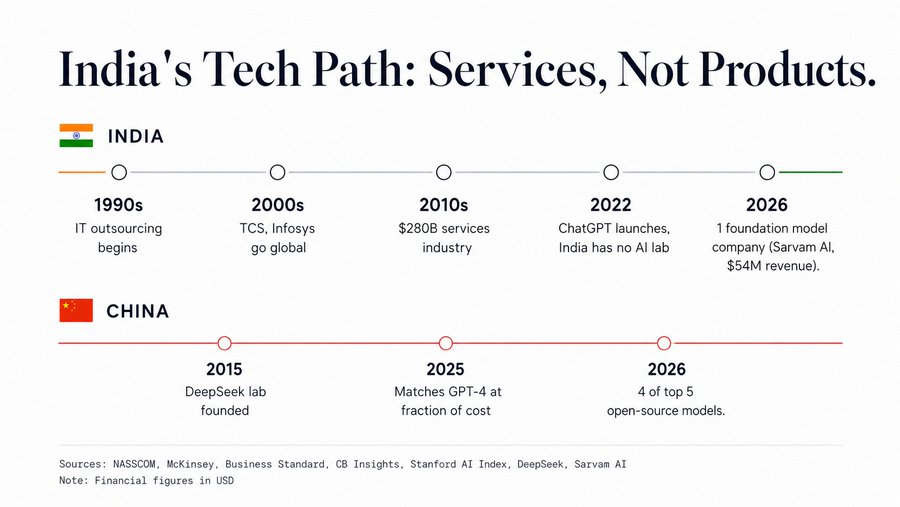
And yet. India has exactly one company genuinely building foundation models: Sarvam AI with revenue of $54 million. The gap between India's best model (Sarvam 105B) and the global frontier is, according to explainx.ai's sovereign AI analysis, "roughly three to four years of compute-scaling advantage."
Meanwhile, DeepSeek, a Chinese lab most people hadn't heard of two years ago, matched GPT-4 performance at a fraction of the cost. China now has four of the five best open-source models in the world. Anthropic went from zero to $47 billion ARR. India's contribution to frontier AI in 2026? Basically nothing.
This is the paradox I can't stop thinking about.
### 1. We Built the World's Best IT Services Industry. That's the Problem.
This is the root cause, and nobody in India wants to hear it.
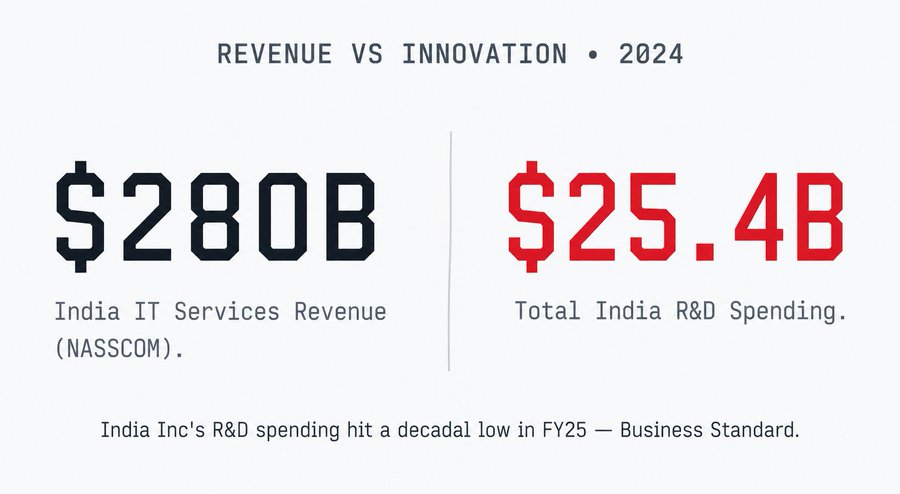
India's $280 billion IT outsourcing industry - TCS, Infosys, Wipro, HCL - is one of the country's proudest achievements. According to NASSCOM, it directly supports 5.67 million IT professionals and is tied to the livelihoods of nearly 25 million people when you count families and supporting industries. IT services and BPO exports account for roughly a quarter of India's total exports.
But here's what that industry optimised for: cheap labour arbitrage, not innovation.
According to The China Academy's analysis, Indian IT giants "prefer expanding manpower to meet client needs rather than risking R&D investment. They hire low-skill labour to lengthen project cycles instead of employing high-skill talent to improve efficiency." The billing model literally incentivises longer, less efficient projects. More people = more billable hours = more revenue. Why would you invest in AI that does the same work with fewer people?
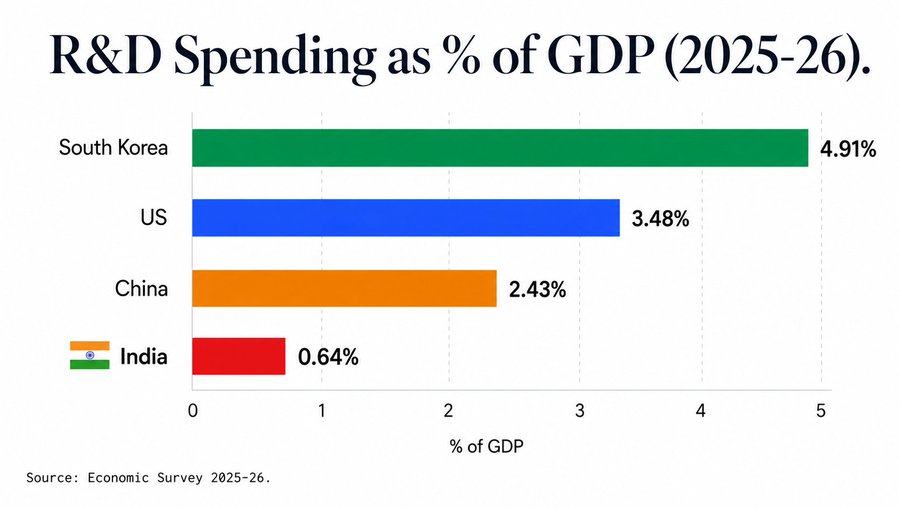
The numbers are brutal. India's R&D spending sits at 0.64% of GDP according to the Economic Survey 2025-26. The US spends 3.48%. China spends 2.43%. South Korea spends 4.91%. Even worse, as reported by Business Standard, India Inc's R&D spending hit a decadal low in FY25 because most companies prioritised record shareholder payouts over innovation.
As The Wire put it: "India's innovation problem is not merely a government problem. It is a corporate problem."
The five biggest IT outsourcing companies had a combined market cap exceeding $500 billion, yet their R&D spending remained, in the words of The China Academy, "extremely limited." They never climbed the value chain. They never built products. They coded what Silicon Valley designed.
### 2. We Export Our Best Talent and Can't Get Them Back
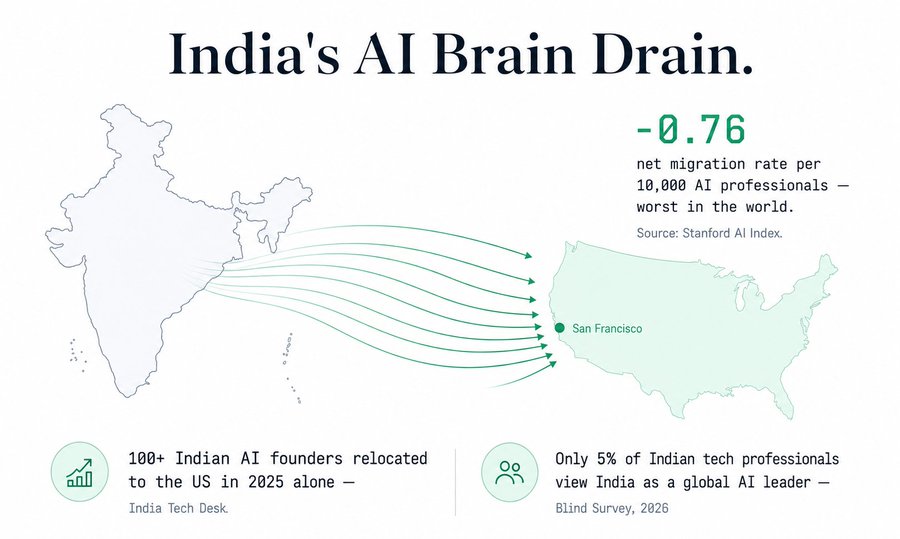
India has the world's worst AI brain drain. According to Stanford's AI Index, India has a net AI talent migration rate of -0.76 per 10,000 LinkedIn members with AI skills. That's the highest outflow of any country measured, worse than Israel and South Korea.
According to Forbes India, many Indian AI researchers working in Silicon Valley say they have "little incentive to return home." More than 100 Indian AI founders relocated to the US in 2025 alone, even as the domestic startup ecosystem attracted record investment.
Mansoor Rahimat Khan, co-founder of Beatoven.ai, told India Tech Desk when he moved to the US in 2024: "When you are building in AI, it is important to be close to the ecosystem and density of talent. Right now, that is the U.S."
The pattern is decades old. India trains world-class engineers at IITs and IISc. The US hires them. OpenAI, Google DeepMind, Anthropic, Meta AI — look at the research teams. They're full of Indian-origin talent. But that talent builds for American companies, not Indian ones.
India is basically running a subsidized training program for Silicon Valley. We pay for the education, they get the output.
### 3. No Chips, No Game
You can't train frontier AI models without massive GPU clusters. India doesn't make a single AI chip.
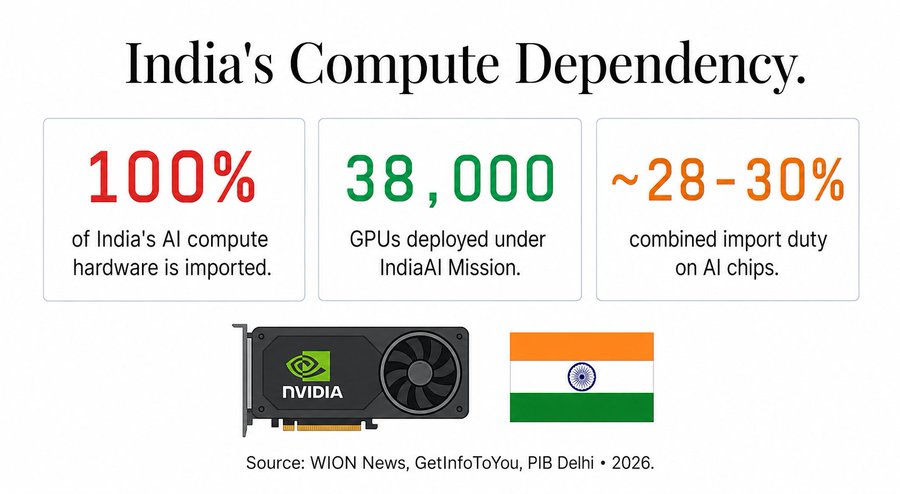
According to WION News, India's entire compute base is 100% imported hardware, mostly NVIDIA H100, H200, and Blackwell GPUs. The government's IndiaAI Mission has deployed over 38,000 GPUs at subsidised rates (Rs. 65 per GPU-hour, roughly 72 cents). That sounds good until you realize OpenAI, Anthropic, and Google each operate clusters with hundreds of thousands of GPUs.
India is classified as a "trusted partner" under US export controls, which means companies can import advanced chips. But imported GPUs face roughly 28-30% combined duty (7.5% customs + 18% IGST), according to a GetInfoToYou analysis of 2026 import policies. And there's no guarantee this access stays stable; US export control policy shifts with every administration.
The Tata-PSMC fab in Dholera, Gujarat, is targeting first silicon by the end of 2026. Micron has an assembly facility in Sanand. But here's the thing: none of these plants target AI chips. They do memory packaging and basic fabrication. According to explainx.ai, "compute sovereignty requires either domestic chip design and manufacture a decade-plus project at minimum or guaranteed access treaties."
India's data centres are growing, sure. Reliance is building a 1-gigawatt facility in Gujarat on NVIDIA Blackwell processors. But as WION reported, "India's current AI infrastructure is mostly foreign-funded and foreign-chip-dependent." We're building on rented land.
### 4. R&D Spending That's Genuinely Embarrassing
The Carnegie Endowment for International Peace published an analysis of India's AI puzzle. Their finding: India's overall R&D spending is approximately 0.6% of GDP, compared to innovation-focused countries that typically average 3-4%.
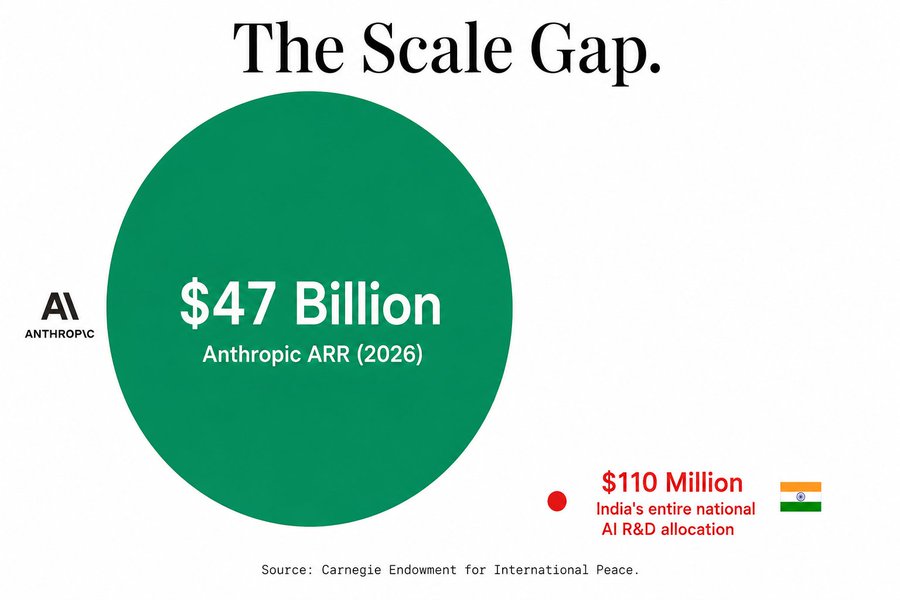
But it gets worse. The IndiaAI Mission, the government's flagship AI initiative, allocated the majority of its Rs. 10,000+ crore budget to GPU infrastructure and startup financing. The amount specifically allocated to R&D through Centres of Excellence? Roughly Rs. 990 crore. That's approximately $110 million.
For context: Anthropic's annualised revenue alone is $47 billion. OpenAI raised $6.6 billion in a single funding round in 2024. India's entire national R&D allocation for AI is what a mid-tier Silicon Valley startup spends on a quarterly compute bill.
According to a Blind survey of 1,723 India-based tech professionals (March-April 2026), 62% said the lack of homegrown R&D is a critical bottleneck. Only 5% viewed India as a global leader in AI. 53% said India is straight-up "behind."
### 5. 22 Languages, 1.4 Billion People, Zero Data Infrastructure
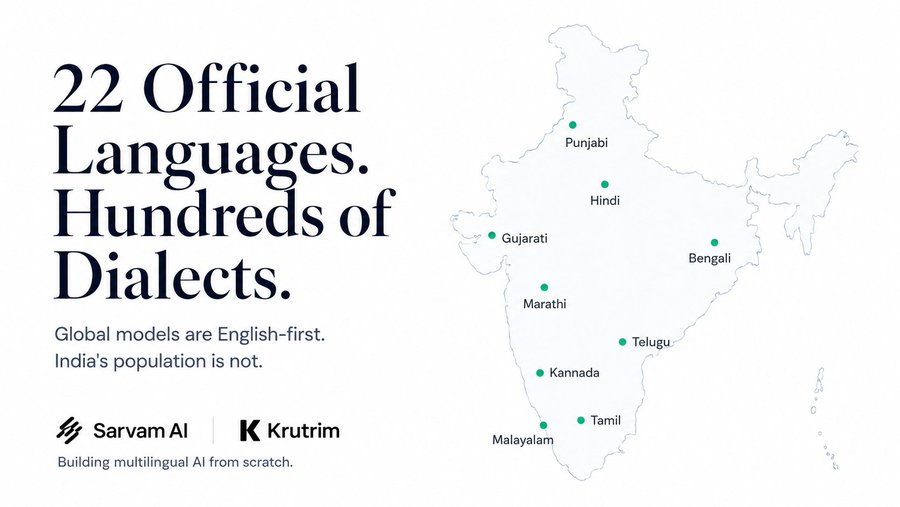
India has a genuine, unique challenge that the US and China don't: linguistic diversity. 22 official languages, hundreds of dialects, massive code-switching in daily conversation.
Global models like GPT and Claude struggle with this. They're built for English first, everything else second. India needs models that handle Hindi, Tamil, Telugu, Bengali, and a dozen others natively, and that's genuinely hard.
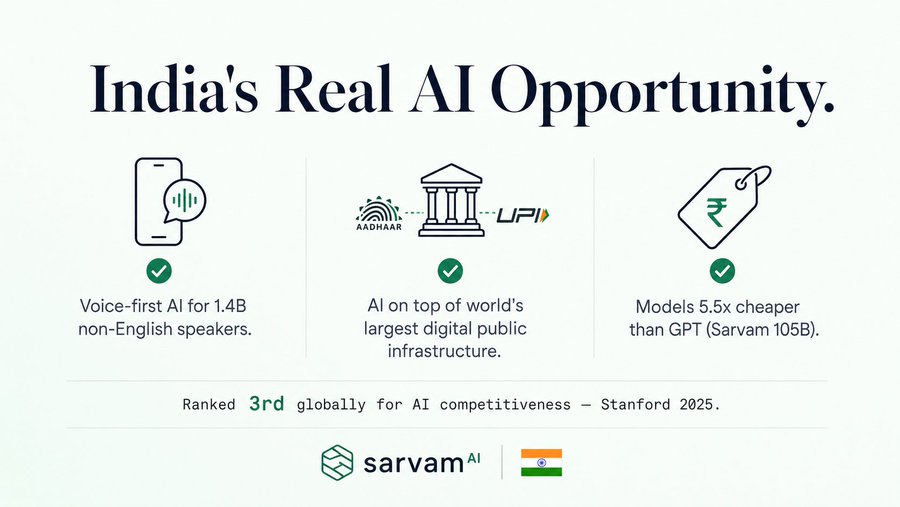
Sarvam AI is building for this. Their 105B model handles 22 Indian languages and claims to match GPT-5.4 Mini on voice call capabilities while being 5.5x cheaper. Krutrim's model was trained on 2+ trillion tokens across Indian languages. But these are 105-billion and 12-billion parameter models. The global frontier is at trillions of parameters.
And then there's the data quality problem. As The Wire reported, "India's data tends to be siloed, unstructured, unlabeled and inaccessible, leading to inaccurate AI outputs." Government data quality is poor. Metadata is scarce. And the data that does exist in Indian languages? There's far less of it on the internet compared to English and Chinese content.
### 6. We Never Entered the Race
Here's the thing nobody wants to say out loud: India didn't lose the AI race. India never entered it.
As the China Academy put it: "India's absence from the AI era is not an accident. It is the inevitable consequence of the industrial path it has followed."
India's tech trajectory for 30 years has been: service other countries' technology needs. Build what they design. Staff what they architect. Bill by the hour. It worked spectacularly well: IT exports became a pillar of the economy, built an entire middle class, and created global brands in TCS and Infosys.
But it also meant India never built the muscle for creating technology. The incentive structure pushed people toward getting a job at Google, not starting a lab. The capital markets rewarded stable cash flows from outsourcing, not risky R&D bets. The education system optimised for employability at US companies, not fundamental research.
According to Forbes India's Council analysis, OpenAI was founded in 2015 and worked quietly for nearly a decade before ChatGPT. The teams that built these models didn't appear overnight. India doesn't have that kind of deep institutional research culture outside of a few pockets like IIT Madras's AI4Bharat initiative.
As of mid-2026, India has three AI unicorns. China has dozens. The US has over a hundred. That gap didn't happen overnight; it's the accumulated result of three decades of choosing services over products, execution over innovation, and employment over entrepreneurship.
### But There's a Different Game India Can Play
Here's where I'll push back on the doom narrative, because the full picture isn't that simple.
India ranked third globally for AI competitiveness in the Stanford Global AI Vibrancy 2025 report. The country has 100 million weekly ChatGPT users, second in the world. AI-related job postings increased 16% even as overall IT hiring declined 3%.
Former UK PM Rishi Sunak said at the India AI Impact Summit: "Leadership in technology does not just depend on inventing technology; it's about how you deploy it."
India may never build the next GPT or Claude. That might be okay. What India can build - and what Sarvam, Krutrim, and the AI4Bharat initiative are showing - is AI infrastructure for a billion people who don't speak English as their first language. Lightweight models that run on cheap Android phones over poor networks. Voice-first AI for a country where typing in your mother tongue is still a pain.
That's not the glamorous frontier-model race. But it might be more important.
The real question isn't whether India can compete with OpenAI. It's whether India can avoid becoming permanently dependent on American and Chinese AI infrastructure for its own digital economy. That's the sovereignty question. And with 100% imported chips, zero domestic foundation models at the frontier, and the best talent still flying to San Francisco, that question is far from answered.
Back to Blog